




GUIDE CV02
HOW TO: Get the most from your Caravan over the Winter
In our last guide we looked at preparing your caravan for winter storage. But there is no rule that says that you can't enjoy your caravan all the year round. Modern caravans with all their comforts are comfortable and warm homes whatever the weather outside.
Towing a caravan in the winter is however more challenging than in the summer however, so new caravanners may wish to get a few seasons of summer touring under their belts before venturing out into the wilds of winter.
If you are considering winter touring however - there are a few essential items you should carry with you, in addition to the regular inventory of summer accessories, and those pre-journey safety checks are vital.
BEFORE SETTING OFF:
- Always check the condition and pressure of tyres - on the car and caravan, and including the spare. (Although this check applies whatever the season or the weather)
- Ensure that your towcar's antifreeze level is adequate - temperatures in the countryside can drop harshly. Your local garage will be able to check and top up if necessary, your antifreeze, or for those who enjoy self-reliance, a motor factor will be able to supply a simple antifreeze hydrometer quite cheaply. Carry spare antifreeze with you - if you need to top up your coolant water for any reason, you must add antifreeze too, following the mixture ratio on the antifreeze bottle.
- Ensure your screenwash is fully topped up. This means topped up with screenwash and water, mixed to the ratios on the screenwash bottle, which as well as cleaning, resists freezing. DO NOT mix coolant antifreeze with the screenwash - this can damage or strip your vehicle's paintwork.
- Check your oil, power steering fluid and all other fluid levels.
- Check the condition of your vehicle's battery and alternator. Again, a local garage should be able to perform this check. Batteries take far more punishment in the cold weather so it is vital that both the vehicle battery and charging systems are in tip-top condition.
- Check all vehicle and caravan lights - and carry a good selection of spare bulbs and fuses. Good lighting is imperative in poor weather conditions. Periodically check all lights throughout your journey - a two minute check when leaving a service station stop could prevent an accident.
- If you use butane gas, remember that this liquefies ("freezes") quicker than propane. Consider switching to propane bottles and regulator if possible, otherwise cooking and heating may become difficult.
CARRY WITH YOU:
- Your mobile phone. Ensure it is fully charged. If you have two phones, consider keeping one switched off for use as an emergency phone only. An Emergency Mobile Phone Charger allows topping up of flat telephone batteries if no other power is available.
- Ensure you also have your breakdown association's phone numbers to hand. And double-check that your subscription is active.
- A bright torch with spare batteries. A Wind Up Torch is also a good power-free emergency item.
- Grip Tracks are great for gaining initial traction on slippery grass. However they can slip on packed ice - a piece of old carpet makes a good traction surface as an alternative to expensive bridging ladders (waffles). Though carpet should be a last resort as it has to be packed up and carried when wet - grip tracks can be easily wiped dry.
- Your caravan wardrobe should include warm clothing and extra blankets. Also carry some of this warm clothing and blankets in your car, should you get stuck on an excursion or for any reason be unable to access your caravan.
- Some Bubble Wrap - available from most good stationary or office suppliers. This makes great emergency insulation. This can be used to line lockers to retain warmth and prevent overnight damp - but ensure all airvents are kept free and unblocked.
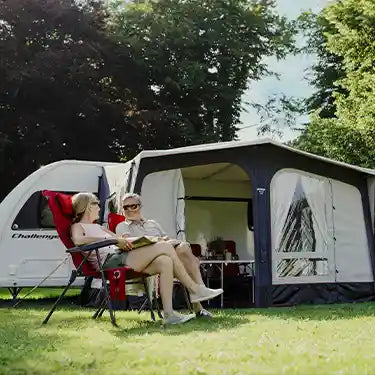
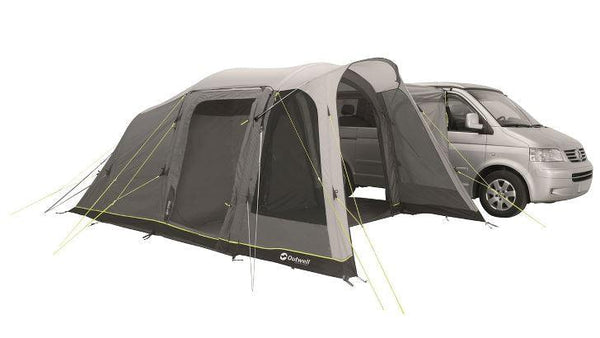
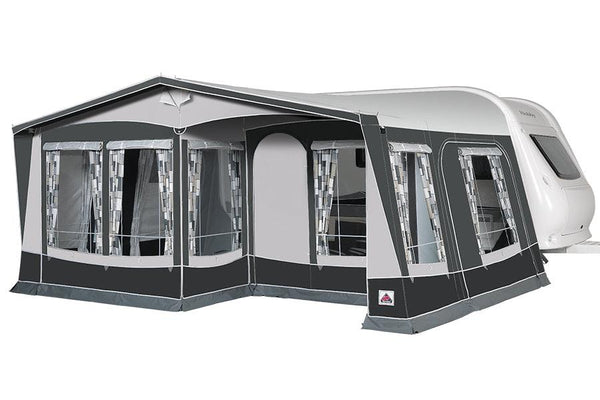
- A Porch Awning is more suited to winter use than a full-size awning which can get weighted down by snow or heavy rain. A porch also provides an excellent area for taking off muddy or wet boots before entering the caravan. If you intend to take an porch, take with you heavy duty pegs such as metal thread pegs in case of strong winds - and also to allow them to be inserted into hard frozen ground.
WHILST ON-SITE
- Fill your kettle every night before going to bed. Should your water have frozen, you will still be able to have a hot drink on a cold morning.
- Bring your water carrier into the caravan every night. If you really don't have room for it, wrap it in a Jacket with a double layer of bubble wrap to help insulate it and prevent freezing. Wrap some pipe lagging (from any DIY store) around the inlet hose.
- DO NOT be tempted to block vents to keep in the warmth. Vents do allow a little cold air in but vitally, they allow condensation to escape and prevent expensive damp problems.
- Don't forget your waste water container. That can freeze too - a major inconvenience when trying to empty it. As for the water carrier, wrap it in a jacket of bubble wrap and if there is room, stand it on a polystyrene block. Pour salt into the tank to help prevent freezing. Adding antifreeze is not recommended for it's effect on the environment when it is disposed of.
<< Back to Index
|